
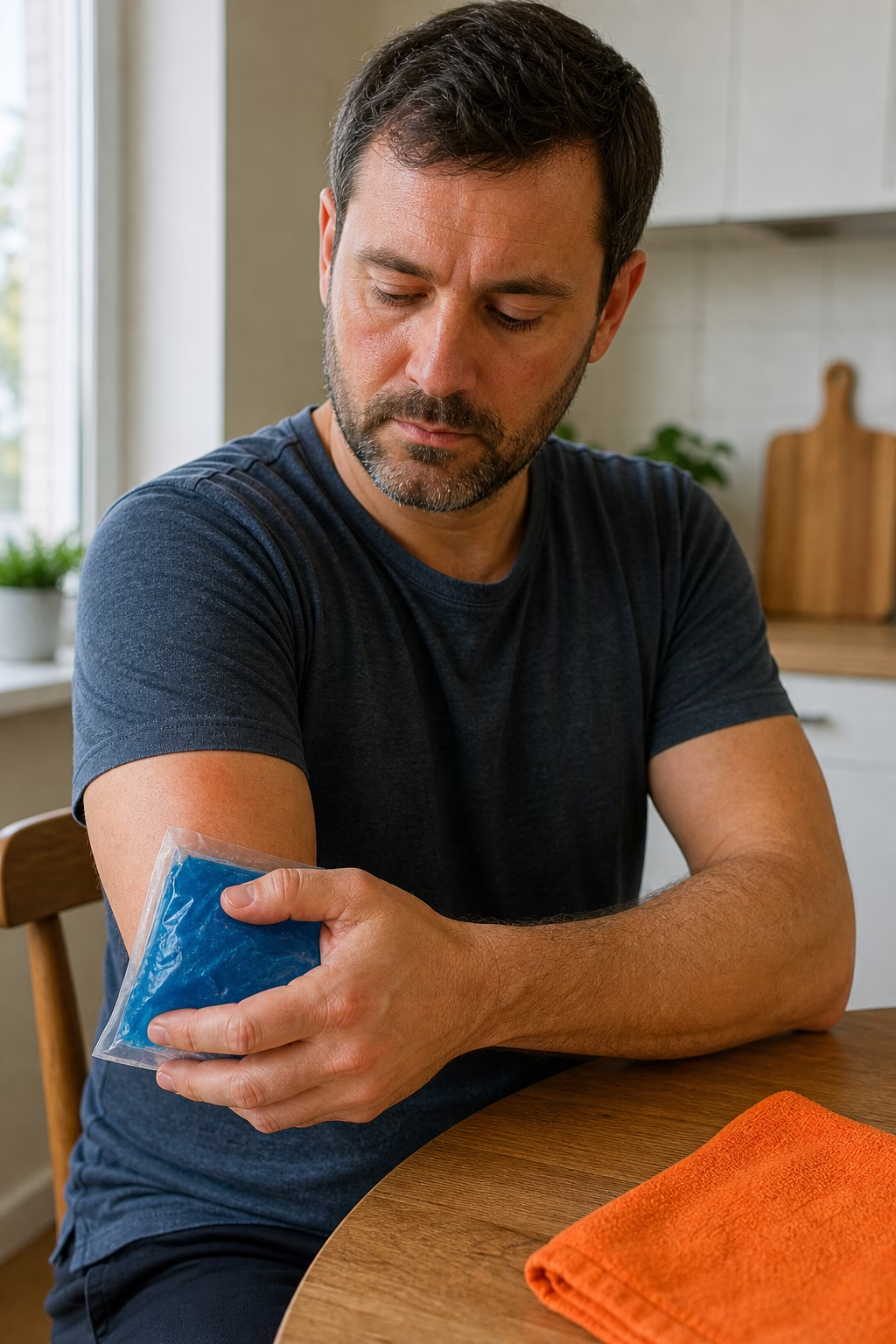
Tennis elbow can turn a handshake or a coffee cup into a sharp jolt of pain. The good news? Most cases get better with the right exercises and a bit of patience. This guide walks you through six clear steps, from calming the pain to getting back to your sport, using the same approach a physiotherapist would. Let’s start with making sure you actually have tennis elbow.
Step 1: Understand and Confirm Your Tennis Elbow
Before you start any physiotherapy exercises for tennis elbow, you need to confirm that’s what you’re dealing with. Tennis elbow, or lateral epicondylitis, is pain on the outside of your elbow. It comes from tiny tears in the tendons that link your forearm muscles to the bone above your elbow.
It builds up over time from repeated wrist and arm use. You don’t have to play tennis to get it. Painting, plumbing, typing, and using hand tools all stress the same tendon. According to healthdirect Australia, tennis elbow affects about 2 in 100 people aged between 30 and 65.
Here’s how to spot it:
- Soreness on the bony bump on the outside of your elbow
- Pain that spreads into your forearm
- A weak grip, like when you try to open a jar or turn a doorknob
- Pain when you shake hands or lift a cup
Press on the outside of your elbow. If that spot is tender and sore, that’s a classic sign. The Cleveland Clinic notes that diagnosis is usually made by physical exam, though an X-ray or ultrasound may be used to rule out other problems.
If you’re not sure, get it checked. A physiotherapist can confirm the diagnosis and rule out nerve or joint issues that mimic tennis elbow. At Dynamic Balance Physio, our therapists assess your elbow pain and build a plan around your stage of healing, so you’re not guessing about what hurts and why.
Step 2: Calm the Pain Before You Start Exercising
You can’t strengthen a tendon that’s screaming at you. The first job is to settle the pain so your exercises don’t make things worse. Rest is the biggest piece here.
Stanford Health Care calls tendon rest the most important part of treatment. Stop or cut back the activity that caused the problem. That doesn’t mean total stillness. It means avoiding the gripping and twisting motions that flare your elbow.
Try these to bring the pain down:
- Ice: Apply a cold pack to the outside of your elbow for 10 to 15 minutes after activity.
- Relative rest: Keep moving gently, but avoid the specific tasks that trigger sharp pain.
- A counterforce brace or strap: Worn on your forearm, it takes load off the sore tendon during daily tasks.
- Pain relief: Over-the-counter medication can help if your doctor or pharmacist says it’s okay for you.
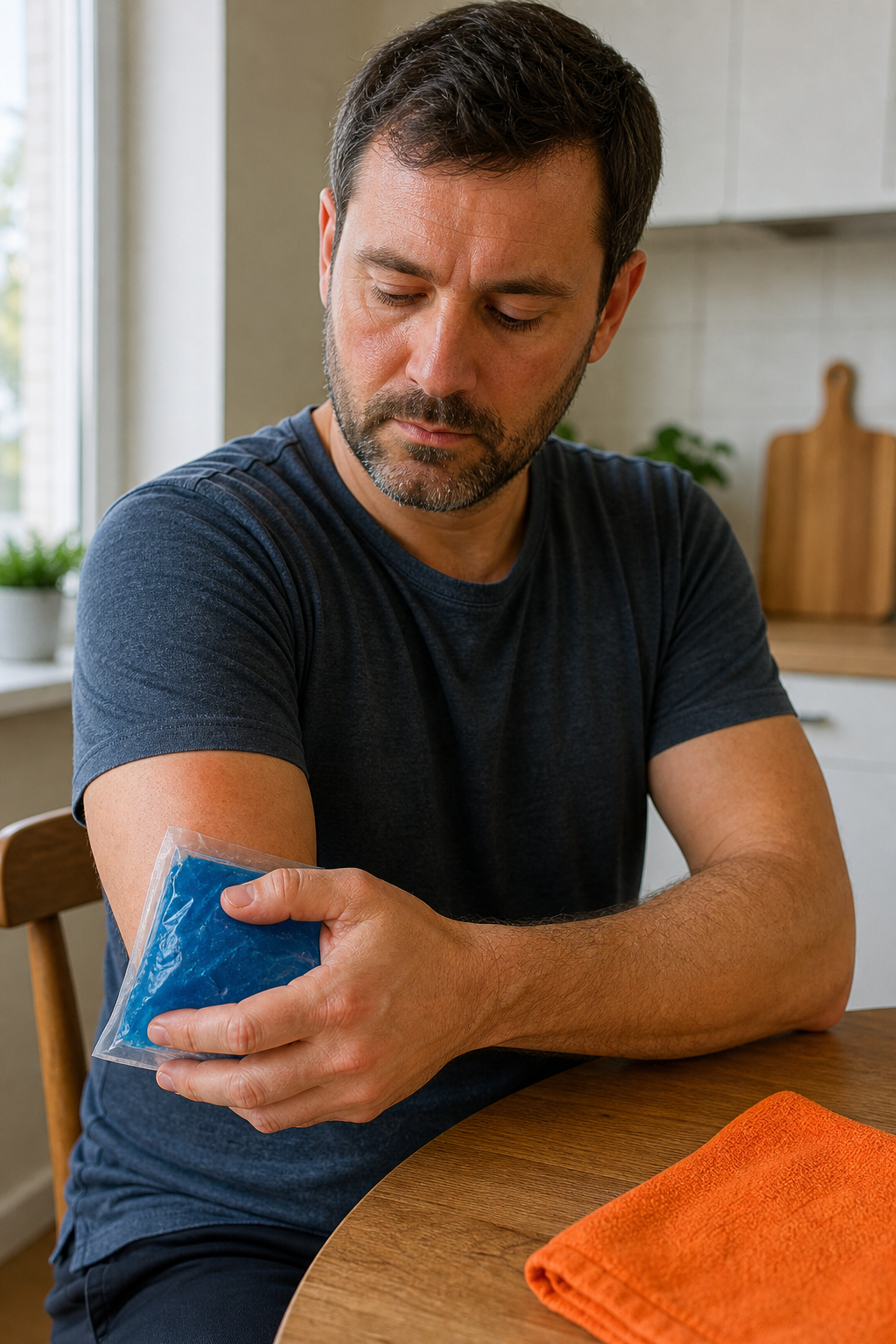
This early phase mirrors the RICE idea, rest, ice, compression, and elevation, that we use for many soft-tissue injuries. If your pain is sharp and limits everyday movement, our team treats sprains and strains with modalities and manual therapy first, then moves you into loading once the tissue settles.
Don’t rush past this step. The longer you keep aggravating the tendon, the longer rehab takes. Give the pain a week or two to ease before you push into the next phase.
Step 3: Start With Gentle Stretching Exercises
Once the worst of the pain has calmed, gentle stretching is where physiotherapy exercises for tennis elbow really begin. Stretching improves how far the tendon can move and brings blood flow to the area, which helps healing.
Start slow. Ease off if pain spikes. Healthwise care instructions, published through Alberta’s MyHealth resource, advise starting each exercise slowly and stopping if you feel pain.
Wrist extensor stretch
This is the main stretch for tennis elbow. Here’s how to do it:
- Hold your sore arm straight out in front of you, palm down.
- Point your fingers down toward the floor.
- Use your other hand to gently press the back of your stretched hand, bending your wrist more.
- Hold for 30 seconds.
- Repeat 3 times. Do this every day.
Wrist flexor stretch
To balance things out, turn your palm up. Point your fingers down, then use your other hand to gently pull your fingers back toward you. You’ll feel the stretch along the inside of your forearm. Hold for 30 seconds and repeat 3 times.
Stretching shouldn’t make your pain worse the next morning. A little discomfort during the stretch is fine. Stretching aligns the collagen fibers in healing tissue and builds your tolerance to load over time. If you want more on why this works, our breakdown of the health benefits of stretching explains how range of motion and pain relief connect.
Step 4: Progress to Isometric and Strengthening Exercises
This is the step that fixes tennis elbow for good. Stretching eases symptoms, but strengthening rebuilds the tendon so it can handle load again. Start with isometrics, then move to eccentric and concentric work.
Isometric wrist extension
Isometrics are gentle holds with no movement. They build strength and calm pain at the same time. Rest your forearm on a table, palm down, wrist over the edge. Place your other hand on top of your knuckles. Push your hand up against that pressure without letting it move. Hold for 10 seconds, then relax. Do 5 to 10 holds.
Eccentric wrist extension
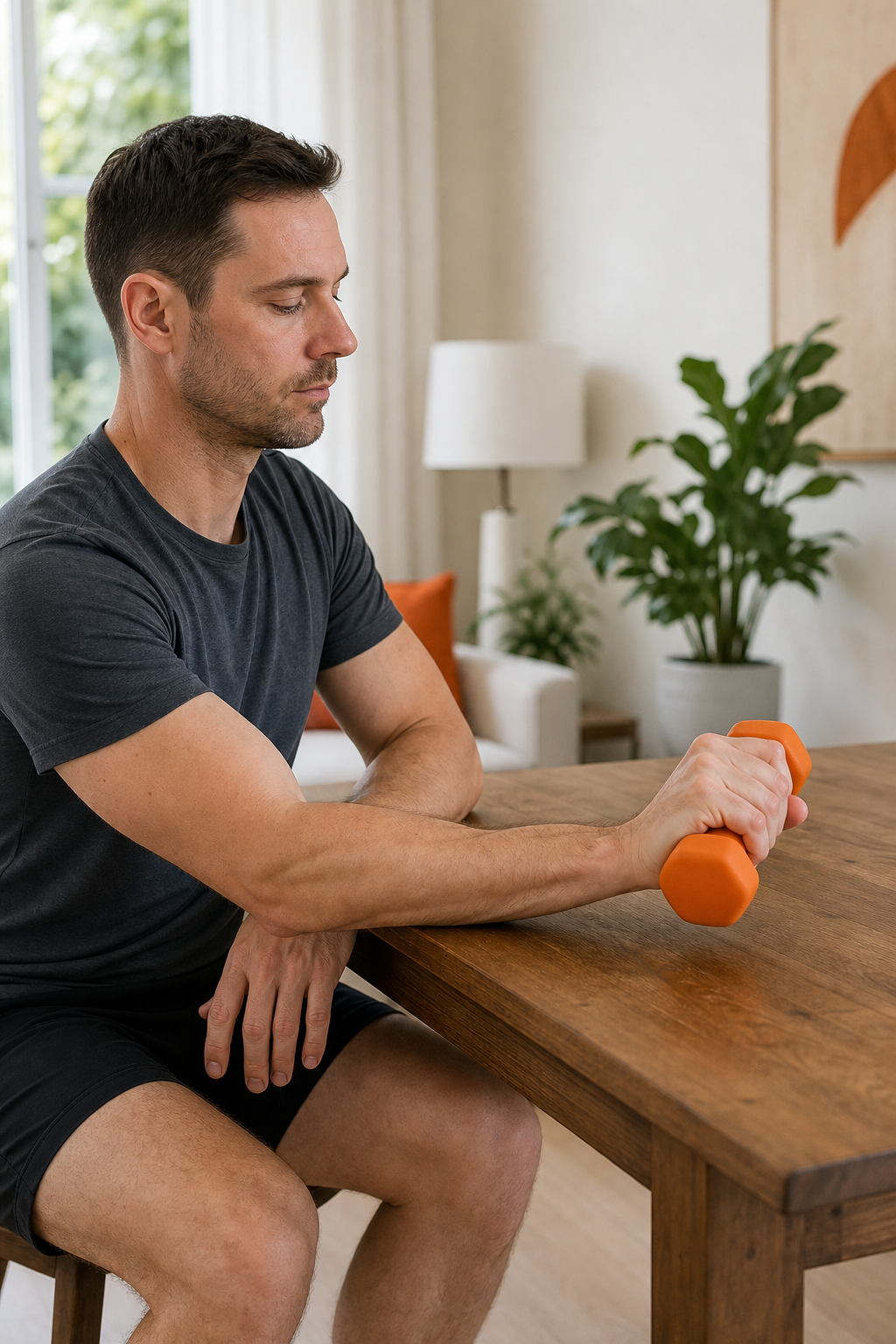
Eccentric work, slowly lowering a weight, is the strongest evidence-based exercise for tennis elbow. A peer-reviewed program published in Canadian Family Physician describes how progressive eccentric and concentric loading builds a dense collagen scar that eliminates pain. Here’s the home version:
- Sit next to a table. Hold a 1 to 2 pound dumbbell, palm facing down.
- Bend your elbow to 90 degrees, forearm supported.
- Slowly lower the weight over 5 to 10 seconds, then slowly raise it back up.
- Do 10 reps, or until it gets too painful or your strength gives out.
- Rest a few minutes, then repeat with your elbow straight and flat on the table.
That study explains an important rule: “good pain” hurts during the exercise but is no worse the next day. “Bad pain” gets worse the morning after. If you feel bad pain, cut back the weight or reps. Once 10 reps feel easy, add 1 or 2 pounds.
This loading approach is the same principle we use for golfer’s elbow, the inner-elbow version of the same problem. The goal is to challenge the tendon enough to drive healing without tipping it back into a flare.
Pain usually starts improving by week 4 to 6 with daily practice. Stick with it for about three months for lasting results.
Step 5: Build a Weekly Routine and Track Progress
A scattered effort gets scattered results. Tennis elbow responds to consistency, so put your physiotherapy exercises for tennis elbow into a simple weekly plan and track how your elbow feels.
The eccentric protocol works best done once a day, seven days a week, for around three months. Stretching can happen more often in small doses. Use a pain scale of 0 to 10 to guide your effort. Aim to keep pain at 5 or below during and after exercise. If pain climbs past that, reduce the reps or the weight.
Keep a short log. Note your pain rating, the weight you used, and how your elbow felt the next day. This tells you when to add load and when to back off. Stanford Health Care points out that most cases take 6 to 12 months to fully heal, so slow, steady progress is normal.
“Consistency beats intensity. Ten minutes daily does more than one long session a week.”
If your pain hasn’t improved after about 6 weeks of honest effort, that’s the signal to get a professional eye on your program. A physiotherapist can adjust your load, check your technique, and add manual therapy to move things along.
Step 6: Return to Sport and Prevent Recurrence
Getting back to your sport or work is the final step, and the one people rush. Tennis elbow has a high rate of recurrence, so a slow, planned return protects all the work you’ve done.
Don’t jump straight back to full activity. Ease in. Start with shorter sessions and lighter loads, then build up as your elbow tolerates it. Your forearm should feel strong and pain-free through your exercises before you ramp up the activity that caused the problem.
To keep tennis elbow from coming back, focus on a few habits:
- Warm up first. A few minutes of gentle movement gets blood flowing to the forearm before hard use.
- Fix your technique. Poor form, an oversized grip, or the wrong equipment all overload the tendon. A coach or therapist can spot this.
- Take breaks. For repetitive tasks, pause every hour to give the tendon a rest.
- Keep your forearm strong. Don’t drop the strengthening exercises the day your pain ends. Keep wrist curls and grip work in your routine.
The same step-by-step thinking applies to other upper-body injuries. If you’re rebuilding after a different injury, our guide to rotator cuff rehab exercises uses the same load-and-progress approach for the shoulder.
If you’ve had tennis elbow before, treat prevention as part of your normal routine, not an afterthought. The tendon that tore once is more likely to tear again without ongoing care.
Frequently Asked Questions
How long does it take for physiotherapy exercises to heal tennis elbow?
Pain from tennis elbow usually starts easing after 4 to 6 weeks of daily exercises, but full tendon healing can take 6 to 12 months. The eccentric strengthening program works best done once a day, seven days a week, for about three months. Progress is slow and steady, so stay consistent even when results feel gradual.
Should I keep exercising if my elbow hurts?
Some pain during exercise is normal and expected with tennis elbow rehab. The rule is “good pain” versus “bad pain.” Good pain hurts during the exercise but is no worse the next morning. Bad pain is worse the day after. If you feel bad pain, reduce your reps or the weight you’re lifting.
What is the best exercise for tennis elbow?
Eccentric wrist extension, slowly lowering a light dumbbell, has the strongest evidence for healing tennis elbow. Hold a 1 to 2 pound weight palm-down, lower it over 5 to 10 seconds, then raise it. Pair it with a daily wrist extensor stretch and isometric holds for the best results over about three months.
Can tennis elbow heal without physiotherapy?
Tennis elbow often improves on its own with rest, but recovery is slow and can take 6 to 12 months. Targeted physiotherapy exercises for tennis elbow tend to reduce pain faster and rebuild strength so the tendon can handle load again. If pain hasn’t improved after 6 weeks of self-care, see a physiotherapist.
When should I see a physiotherapist for tennis elbow?
See a physiotherapist if your elbow pain hasn’t improved after 6 weeks of rest and home exercises, or if it’s limiting your work or daily life. A therapist confirms the diagnosis, adjusts your exercise load, and adds manual therapy. Dynamic Balance Physio builds a personalized plan around your stage of healing.
Conclusion
Tennis elbow gets better when you calm the pain first, then load the tendon slowly with stretching and eccentric strengthening over a few months. Start with the wrist extensor stretch and the eccentric dumbbell lower, track your pain at a 5 or below, and stay consistent. If you’re stuck after six weeks, book an assessment with Dynamic Balance Physio and explore our elbow pain relief program for a plan built around your recovery.