

Top 10 Ankle Sprain Physiotherapy Exercises
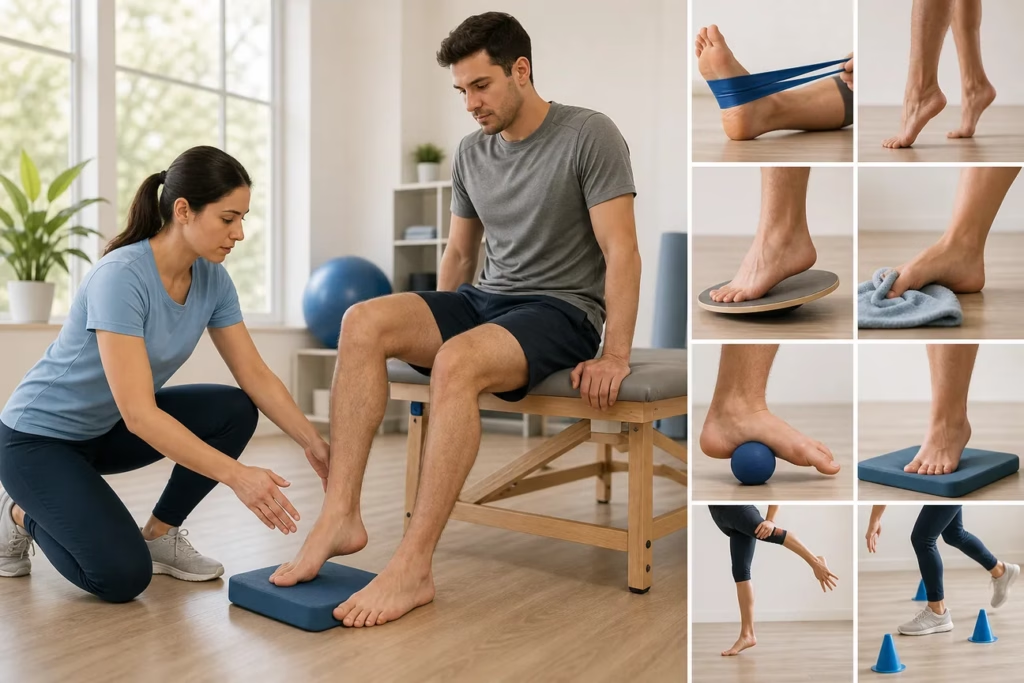
Twisted your ankle on a run or a court? Pain and stiffness can keep you off your feet for weeks. Below are the 10 best ankle sprain physiotherapy exercises that get you moving again, plus a quick tip on when to call a professional.
⚠️ Disclaimer: This content is for educational purposes only. Please consult a qualified physiotherapist before attempting any of these exercises or starting a rehabilitation program.
Grades of Ankle Sprain
- Grade I – mild stretch: Ligaments are stretched but not torn. Mild swelling, minimal pain, and little loss of function. Typically able to bear weight.
- Grade II – partial tear: Some fibers are torn, causing moderate swelling, bruising, and pain. Weight‑bearing is possible but uncomfortable; stability is reduced.
- Grade III – complete tear: Ligament is fully ruptured. Significant swelling, bruising, severe pain, and marked instability. Often unable to bear weight without assistance.
Primary RICE Protocol
Before diving into exercises, start with the fundamental RICE steps to manage inflammation and protect the joint.
- Rest: Avoid weight‑bearing activities for the first 24–48 hours; use crutches or a supportive boot if needed.
- Ice: Apply a cold pack for 15–20 minutes every 2–3 hours during the initial 48 hours to reduce swelling.
- Compression: Wrap the ankle with an elastic bandage (20‑30 mmHg) to limit swelling, but ensure it’s not too tight.
- Elevation: Keep the ankle above heart level whenever possible, using pillows or a recliner.
1. Alphabet Tracing – Gentle ROM for Early Recovery
Alphabet tracing uses your big toe to draw letters in the air or on the floor. It moves the ankle through a full range without forcing any joint.
The move is painless when you stay within a mild stretch zone. It’s ideal for the first week after a sprain when swelling is low and you need to keep the joint from locking up.
Research shows early range‑of‑motion work reduces stiffness and speeds up healing (see Wikipedia for ankle sprain basics). Do one set of the whole alphabet twice a day.
Watch your ankle follow each curve. If a letter hurts, stop and skip it until the pain eases.
2. Calf Stretch – Prevent Stiffness in the Achilles
The calf stretch targets the gastrocnemius and soleus, muscles that pull on the Achilles tendon.
Stand facing a wall, place both hands on it, step one foot back and keep the heel down. Lean forward until you feel a stretch in the back of the lower leg.
Hold for 20‑30 seconds, repeat three times per side. Keep the stretch pain‑free , a gentle pull is fine.
Doing this early restores ankle dorsiflexion and cuts the risk of chronic tightness.
3. Ankle Isometrics – Activate Muscles Without Movement
Ankle isometrics contract the surrounding stabilizers while the joint stays still.
Press the foot into the floor in four directions , up (dorsiflexion), down (plantarflexion), inward (inversion) and outward (eversion). Hold each press for five seconds, then relax.
Start with one set of ten seconds per direction, twice a day. The exercise respects the 24‑hour rule: if pain spikes above a mild ache, stop and repeat the previous level.
Our clinic often pairs isometrics with the How to Treat a Sprained Ankle at Home guide to keep patients moving safely.
4. Resistance Band Eversion – Strengthen the Peroneals
Resistance‑band eversion works the peroneal muscles that guard the outer ankle ligaments.
Anchor a light band to a sturdy object, loop it around the foot, and pull the foot outward against the band’s tension. Perform three sets of 12‑15 reps.
Because the peroneals act as dynamic protectors, strengthening them lowers the chance of a repeat sprain.
Guidelines from the NHS recommend band work once daily once pain is under control (NHS ankle sprain rehab). Adjust the band thickness as strength improves.
5. Resistance Band Inversion – Rebuild Inner Ankle Control
Inversion targets the tibialis posterior and other inner‑ankle stabilizers.
Attach the band to the foot and pull the sole inward, resisting the pull. Do three sets of 12‑15 reps, resting 30 seconds between sets.
Progress by using a tighter band or adding a slow‑eccentric phase (let the foot return to neutral slowly).
This drill balances the work you did in eversion, giving the ankle symmetrical strength.
6. Heel Raises – Foundation for Push‑Off Strength
Heel raises fire the calf and the ankle’s plantarflexors, the muscles that push you off the ground.
Stand with both feet flat, rise onto the balls of the feet, then lower slowly. Begin with two‑leg raises, three sets of 15 reps.
When balance feels solid, shift to single‑leg raises for added challenge.
Our physiotherapists watch for heel wobble , if the heel shakes, reduce the range or hold a chair for support.
7. Single‑Leg Balance Drills – Restore Proprioception
Balance drills retrain the ankle’s sense of position, known as proprioception.
Stand on the injured leg, eyes open, and hold for 30 seconds. Then close the eyes and try again. Aim for three sets.
Progress by standing on an unstable surface like a folded towel or a wobble board.
Studies show that improved proprioception cuts reinjury risk by more than half.
8. Proprioceptive Clock‑Reach – Dynamic Stability Training
The clock‑reach mimics real‑world balance demands. Imagine a clock on the floor; your foot sits at the center.
Shift weight onto the injured ankle and reach the foot toward 12, 3, 6, and 9 o’clock positions, then fill in the intermediate points.
Do two rounds, pausing at each number. The movement challenges both strength and balance.
This drill can improve ankle stability without any equipment.
9. Hip Abductor Strengthening – Support the Kinetic Chain
The hip abductors keep the knee from collapsing inward, which protects the ankle during side‑to‑side moves.
Side‑lying leg lifts are a simple start. Lie on the non‑injured side, raise the top leg up to 45°, hold two seconds, lower. Perform three sets of 12 reps.
Progress to adding a resistance band around the knees for added load.
Strong hips create a stable platform for the ankle, reducing stress on the ligaments.
10. Lateral Hops – Sport‑Specific Agility and Control
Lateral hops train the ankle for quick direction changes.
Start on both feet, hop sideways 10‑12 inches, land soft, then hop back. Do three sets of 10 hops each side.
If you feel sharp pain, cut the distance or switch to a lower‑impact step‑up.
How to Choose the Right Exercise for You
- Early phase (days 1‑7): focus on gentle ROM and isometrics.
- Mid phase (weeks 2‑4): add band work, calf stretches, and balance drills.
- Late phase (weeks 5‑8): introduce heel raises, hip work, and lateral hops.
FAQ
How soon after a sprain can I start these exercises?
You can begin gentle range‑of‑motion moves like alphabet tracing as soon as pain is ≤2/10 and swelling is down. If swelling is still high, stick to rest, ice, compression, and elevation first.
Should I do all ten exercises every day?
No. Start with two or three that match your current phase, then add more as you gain strength and confidence. Overdoing it can trigger the 24‑hour rule and set you back.
What if an exercise makes my ankle hurt?
Stop immediately. Pain that spikes above a mild ache means the load is too high or the movement is off‑track. Scale back or consult a physiotherapist.
Do I need equipment for these moves?
Most exercises need only your body weight and a light resistance band. A sturdy wall, a chair, or a floor mat works for the rest.
When is it time to see a physiotherapist?
If swelling doesn’t improve after 48‑72 hours, if you can’t bear weight, or if the ankle feels unstable after a week of home rehab, book an appointment. Professional hands‑on care speeds recovery and prevents chronic instability.
Ready to get moving? Try the first three exercises today, track your pain levels, and step up the challenge as you feel stronger. And if you need a personalized plan, our team at Dynamic Balance Physio is here to guide you back to full activity.